Healing is not episodic care. Healing is a process of uncovering.
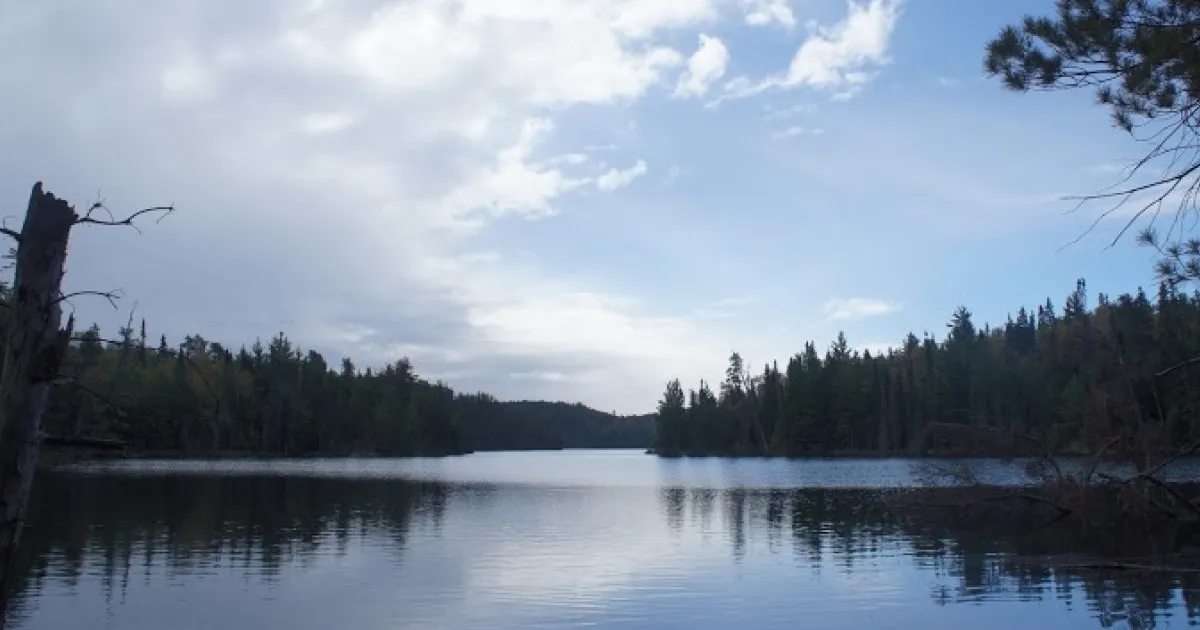
Image: Boundary Waters Canoe Area Wilderness, Minnesota
Doing all the right things and still stuck?
One-off appointments and once-a-year check-ins can be useful snapshots of your well-being. They only show part of the whole, not how you have adapted, changed, and responded over time. They show a moment, not the process.
Aliving™ is a state, but it's also a process and a system. Just as we are a collection of inputs, influences, and context, how we express them is part of who we are right now. Aliving describes a state of being and the process we use to get there.
Where do you start?
Once you know where you want to go, you figure out how to get there; you create a map and choose your path.
I remember looking at the maps of the Boundary Waters. Where did we want to go this year? How many days would we be out? Then we went online, checked which entry points were available, and chose one. From there, we focused on choosing the lake we wanted to end on and the ideal campsite we hoped to snag. Then we looked at the details. The portages on those maps, measured in rods (A rod is 16.5 feet, about the length of one canoe), told us how long they were and hinted at how rough it would be. You didn’t know until you were on the portage, carrying a canoe or pack, how hard or easy it would be. You thought it would be one way until you saw the hill ahead and found yourself picking a path through rocks, mud, puddles, and boulders. You didn’t really feel how long it was or know when it would end until you saw the lake on the other side.
The map is not the landscape.
So even with a map and a direction, you don’t know what you don’t know until you start portaging. You bring the supplies and people you want with you, and you prepare as best you can, because you are stepping into the wilderness.
It is no different with our desire to live and be well. We can know what we want and gather the tools and support, but only by engaging in the process do we discover what is truly expected of us.
When you choose to be well, you have to start somewhere, and I want to share how I think - how I approach something that can feel big, messy, and overwhelming.
For me, the Aliving process is a way of thinking, a way of feeling, and a way to recognize progress.
It is a way of thinking.
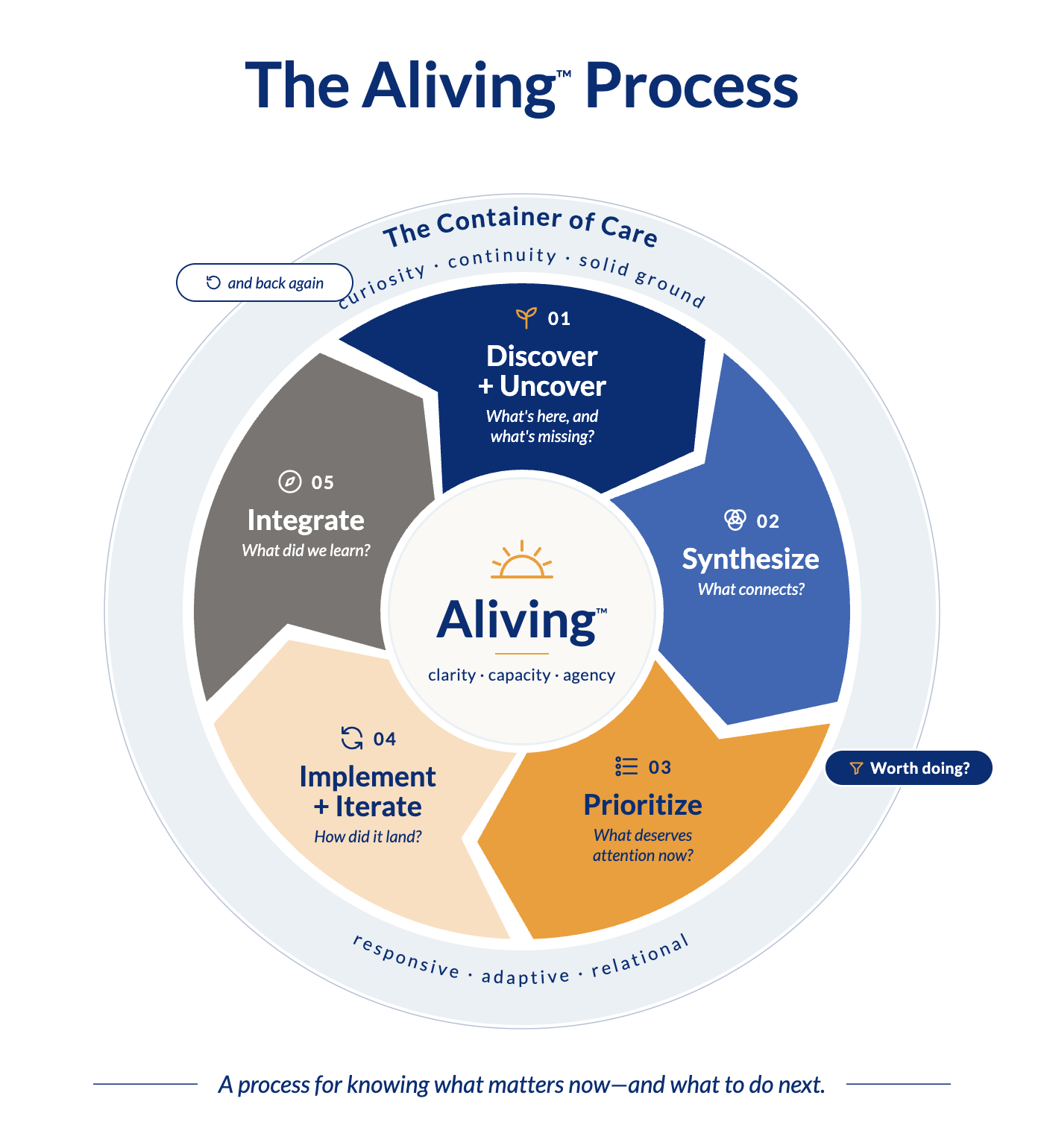
Discovering what is here, what is missing, and what we don’t know yet. Synthesizing the pieces to see what connects and how, rather than viewing things in isolation, one at a time. Prioritizing what matters the most now, for this person.
We start with Discover and Uncover. It is the who, what, why, and the so-what of the woman sitting in front of me. Her past and present matter. So does the person she hopes to become. How did she get here at this exact moment in her life? Who is she? What does she want? How does she want to live her life?
Discovery means looking past symptoms and lab values. In my Foundations appointment, that means a 90-minute deep metabolic dive and whole-person lifestyle assessment designed to reveal her current health status while identifying her resources, strengths, and vulnerabilities.
Underlying this are questions about her patterns. What is a signal? What is noise? What is the biggest issue, and what is contributing to it? What is going well? How has she been compensating? What needs to be left alone?
Of all the things we could address, what deserves attention now?
It is a way of feeling.
We don’t often lean into what we want to feel when we think about our wellbeing.
We are familiar with feeling unmoored, overwhelmed, frustrated, fearful- things all of us have felt, and what my patients feel when they come to me.
I often wonder how healing happens amid all these feelings. When we are fearful, guarded, or braced, these emotions occupy our cognitive and emotional capacity. Everything becomes harder than it needs to be.
Healing requires change.
What do you want your wellbeing to feel like?
For my patients, I want them to feel the container of care, that there is a direction and strategy that focuses on the most important things first, with change happening only at a rate they can respond to. Something can be clinically sound and still land wrong because it’s too much, too soon, for someone with only so much capacity to change. I want it to feel like solid ground.
Something can be clinically sound and still land wrong because it's too much, too soon, for someone who has only so much capacity to change.
Solid ground means knowing nothing important has been disregarded just because we are not addressing it in this moment. We work on “first things first,” see what happens, ask what next, and act, which is how lasting healing occurs.
What does it feel like to be engaged in your wellbeing? To own your Aliving™ state with curiosity and awareness. We try things out and watch what happens.
Change, both expected and unexpected, gives us more information and insight than before.
How would it feel to stay curious, gain clarity, exercise agency, and focus on process, rather than on perfection?
It means embracing responsibility for your life, not as a restriction but as an asset. We have choice, which is good news; the bad news is that we have choice. Choice brings responsibility that can feel like a burden. It means acknowledging that we don’t control everything, but we do have choice over what we do next.
Agency is not control.
At its core, the Aliving process happens in a relationship, a container where discovery, change, iteration, reflection, and integration can occur, honoring the life you are living now and the life you want for your future.
It is a way to recognize progress.
As much as we want and hope progress will be a straight line, more often than not it's anything but. Progress meant adapting.
We had used the Crab Lake entry point before, but this time the portage had changed, moved and elongated a bit, not far from where we were starting. We took off as usual, with our packs and our canoe. The new trail was painfully obvious. It was no longer smooth, but riddled with large rocks patchworked together to support the new trail. This made it hard to stride because there was no single patch of dirt, just rocks and boulders. Five to ten minutes into this rough portage, we figured it out: we took small steps, watching for falls or twists that could break an ankle and slow us down. We took fewer packs and used a “leapfrogging” strategy to reach the end. It was already hot that July day; the extra effort taxed us more. The terrain and landscape had changed. Our destination stayed the same, but we had to approach it differently.
We made progress by adapting to the landscape so we could keep moving forward, reach the end hot and sweaty, with a sense of accomplishment that we made it through.
The landscape had changed; we discovered we couldn’t tackle things the usual way, so we had to adapt and figure out what worked and what didn’t. We knew it would take longer than anticipated, so we slowed down and responded to what was in front of us. Slowing down created progress. Our original plan wasn’t wrong. The new part of the portage made us try new approaches until we found a way through.
In care, that looks like this:
Implement.
Iterate.
Try something and see how it lands.
What changed? What didn’t? What improved? How hard was it to implement? Did anything new come from it?
What do we integrate? What happened with what we chose to integrate?
What do we iterate?
What did we learn?
Completing a protocol in and of itself is not the goal.
The protocol can be part of the process; it isn’t the process.
Worth Doing.
Just because we can, should we?
Choosing what to do first requires weighing the costs in time, money, effort, and capacity against the value of the answers or outcomes that move the process forward. This often means choosing what not to do because the costs would be too high or the benefit isn’t worth what it demands.
The first glimpse of the lake at the end of the portage meant we were almost done, but our planning didn’t end there. Our timing was slightly off, and our energy was lower. We needed to decide whether to stick to our original plan, change it, or modify it. So we pulled out our map and planned our next steps. Back to discovery.
Why a process?
Why spell this all out? We have these assumptions, usually unspoken, about health and healing: that we have a problem, get a diagnosis, get treatment, and now things are resolved, and we are back to our usual self with no lingering issues. Because this happens sometimes, we end up with a mental model that this is how it always happens. For many of the health issues and wellbeing challenges we face, it just isn't that neat.
If you read my previous piece, you know my perspective: everything is connected to everything, not just within the body, but within the context of a human life shaped by history, relationships, environment, goals, perspectives, and future.
The purpose of a process is progress marked by clarity, capacity, and agency, not just completing the steps in a protocol. A process that makes the life we want to live more possible.
Human biology, psychology, environment, and social dynamics cannot be reduced to simple inputs and outputs. We are adaptive, complex systems, and each of us expresses this complexity differently.
The continuous cycle of discovering and uncovering, synthesizing, prioritizing, implementing, iterating, integrating, and back again to discovery gives us a way to navigate the inherent uncertainty of being a constantly changing human in an ever-changing life.
It gives us a way to move through our complex lives, make changes, and take action while letting go of the need for constant certainty.
The map points us in a direction. The process helps us adapt to whatever we uncover along the way.
We don’t need certainty to begin. We need a direction, the capacity to move, and the willingness to respond to what we discover and keep moving forward toward the life we want to live.
